
If you are coordinating a massive event at ADNEC or setting up a major company milestone at a luxury venue in Dubai, you cannot afford to guess logistical details. Miscalculating a timeline by even forty-eight hours means your delivery arrives at an empty hall after your guests have already gone home. On the flip side, ignoring order thresholds means you end up paying ridiculous surcharges that completely destroy your marketing margins.
To help you get your bulk corporate shipments delivered right on schedule without the corporate headaches, let’s look at exactly how bulk logistics operate across the region, how to navigate manufacturer limits, and how to plan a stress-free timeline for your next customized corporate gifting campaign.
What Actually Is Minimum Order Quantity (MOQ)?
Let’s clear up the confusion around this term right away. A minimum order quantity isn’t just a random number a supplier makes up to force you into spending more cash. It is a strict operational threshold calculated by a workshop to ensure that setting up a heavy production run makes financial sense.
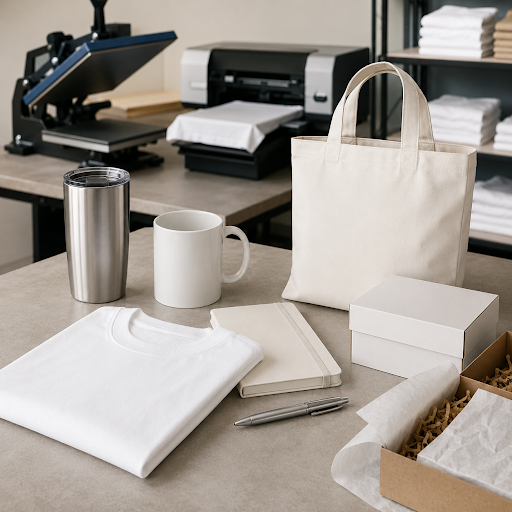
When a branding facility prepares to print your logo or execute a customized gift concept onto a batch of items, they don’t just hit a button on a desktop printer. Setting up a commercial production run involves significant manual labor. Machines have to be completely stripped down, unique physical stencils or digital calibration settings must be built from scratch, and raw materials must be allocated.
If a factory sets up an industrial screen-printing line that requires two hours of physical labor just to calibrate the colors, running a batch of only ten items is a financial loss for them. The labor costs alone would completely eclipse the profit margin on those ten pieces. By enforcing a strict order threshold, suppliers distribute those heavy upfront setup costs across hundreds or thousands of identical units. This allows them to offer you those deep cost-per-unit bulk discounts that make large promotional campaigns viable in the first place.
How Customization Choices Completely Change Your Order Minimums
The exact number of items you must purchase varies widely depending on the specific product you choose and the technical complexity of the branding method you want to use.
Off-the-Shelf Regional Stock
If you choose items that a supplier already holds in large quantities inside a local warehouse in Dubai or Abu Dhabi, your ordering minimums will be remarkably low. Because the raw physical inventory is already sitting in the country, the supplier only needs to run the items through their local workshop for quick logo application. In these common scenarios, you can easily secure low thresholds for batches of personalized gifts. You can often secure order minimums as low as twenty-five or fifty units per batch. This is a perfect strategy for tight turnarounds or small executive meetings.
Completely Custom Global Manufacturing
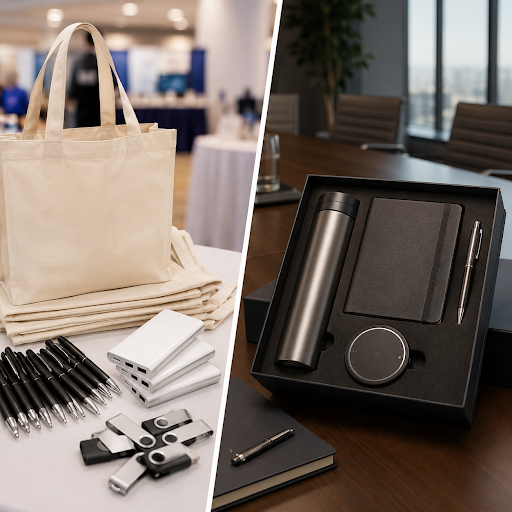
The rules change completely when you want something entirely unique built from scratch. For example, if you want a fully custom wireless power bank molded to the exact shape of your corporate logo or a specific canvas tote bag dyed to a very precise, non-standard Pantone shade, local warehouses cannot help you.
The supplier has to source this order directly from overseas manufacturing plants. Because an international factory has to dedicate an entire assembly line to your project and ship it via air or sea freight, they will enforce incredibly high order minimums. For bespoke global manufacturing projects, you should expect minimum thresholds of 500 to 1,000 units.
Breaking Down Lead Times: The Journey from Digital Proof to Your Desk
Lead time is the total number of business days required from the moment you pay your production deposit to the moment the delivery truck rolls up to your office doors. Many procurement teams make the mistake of assuming that if a supplier says a job will take five days, the items will be in hand in five days. That is almost never how it works out in the field.
A real-world production timeline is built out of several distinct phases, and a delay in any single one of these phases creates a domino effect across your entire project schedule.
- Digital Proofing and Art Calibration: This initial phase rests entirely on your shoulders and your internal design team. Before a factory drops a single drop of ink or runs a single stitch of thread, it will send you a digital mockup showing exactly how your logo sits on the product. If your design files are blurry screenshots or if your internal marketing board takes four days to debate a font choice, your production slot gets pushed back. Production times do not officially begin until you sign off on a finalized digital proof and the accounting team clears your initial invoice deposit.
- Factory Setup and Calibration: Once your proof is locked in the system, the job enters the physical assembly queue. This is where the workshop physically prepares the machinery.
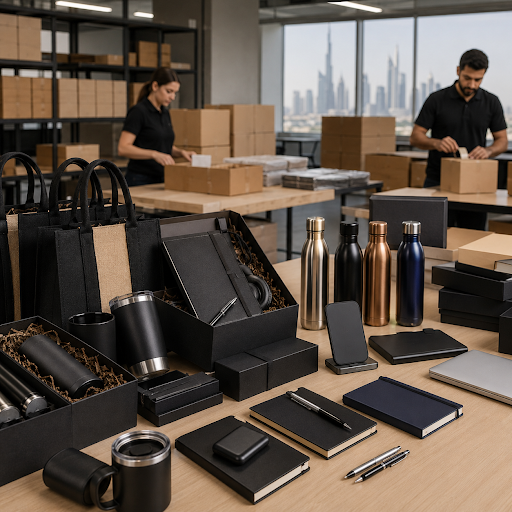
- Bulk Production and Quality Control: Once your design is locked in, the raw items hit the floor for branding. Simple jobs, like laser-etching five hundred metal pens, usually take a technician a single afternoon to complete. However, creating a beautifully curated set of customized gift boxes with mixed tech and notebooks is a completely different story, and it can easily tie up an entire row of industrial finishing lines for days. After the machinery finishes its run, the team still has to pull everything off the line for a manual quality check. This means scanning each item by hand to catch any stray ink smudges, loose threads, or factory defects before the batch is boxed into heavy shipping crates for transit.
- Local Distribution and Delivery Freight: The final leg of the journey is physical transport. If your items are being customized locally in an Abu Dhabi facility, courier delivery to your office takes a day or two. But if your bulk items are arriving from global manufacturing hubs by sea or air freight, clearing customs with regional authorities can add unpredictable days to your final schedule. Always assume that customs inspections will take a little bit of extra time.
A Realistic Operational Timeline for Corporate Orders
To keep your marketing projects completely stress-free, structure your ordering schedule around these realistic regional timeframes.
The Emergency Track (3 to 5 Working Days)
If your event is happening at the end of the week and you need items immediately, your choices are strictly limited. You must pick products that are already sitting in local stock inside the country, and you must use quick branding techniques like laser engraving or digital UV printing. There is zero time for back-and-forth design revisions or custom product color choices. You will also pay a premium price for rush production slots.
The Standard Track (10 to 14 Working Days)
This is the standard window for most regional corporate orders. It gives you plenty of time to review digital proofs, request a couple of adjustments, and let the local workshop run the items through high-quality screen-printing or embroidery lines without any frantic rush.
The Global Bespoke Track (30 to 45 Working Days)
If you are planning a massive end-of-year gala, an international conference, or a massive holiday gift distribution campaign, you want to start the process at least a month and a half in advance. This gives you a wide enough safety buffer to source custom materials directly from global factories, navigate international shipping routes, handle customs clearance at the ports, and complete local deliveries without breaking a sweat.
Smooth Bulk Sourcing with Al Nawras
Trying to juggle multiple print shops, negotiating overseas minimum order thresholds, and stressing over international shipping logistics can easily turn into a massive corporate nightmare. You have an event to run and a business to manage; you shouldn’t have to spend your days micro-managing manufacturing lines.
At Al Nawras, we serve as a premier, direct supplier of premium bulk corporate merchandise, based right here in Abu Dhabi. We handle every single phase of the manufacturing, customization, and logistical pipeline under one roof. We don’t pass your important orders off to unverified third-party workshops.
Head over to our website at Al Nawras Customized Gifts to explore our full merchandise collection or request a clear, competitive quote for your next bulk project today!
Frequently Asked Questions
Can we split a minimum order quantity across different product colors?
It depends entirely on the item and the supplier’s setup. If you are ordering promotional plastic pens and the workshop can use the exact same logo setup without changing the inks, they will often let you split the minimum order across different casing colors.
What happens if our artwork files don’t meet the printing specifications?
If you submit low-quality files, your entire production schedule will slide backward. A factory cannot set up industrial printing machinery using low-resolution web images or phone screenshots, as the final logo will be incredibly blurry and distorted. If our graphics team has to manually rebuild your logo from scratch into a clean vector file format, it adds extra processing time to your initial approval phase.
Is it possible to get a single physical sample before paying for a massive bulk order?
Yes, but you need to budget for the extra time and cost. Creating a single physical sample requires a technician to perform a full production setup just for one item. Most companies prefer to review a highly detailed digital proof because it is instant and free. If your project absolutely requires a physical pre-production sample to assess material quality, you should add an extra 7 to 10 working days to your total planning timeline to account for the sample loop.